Best Compound Bow for Beginners in 2026
The Bear Archery Cruzer G4 RTH ($419.99) is the best compound bow for most beginners because it adjusts from 10 to 70 lb and 14 to 30 inches of draw without a bow press, so one bow fits you now and three seasons from now. For youth and smaller-framed archers, the Bear Limitless ($188.20) does the same job in a lighter package.
The right first compound bow is not the fastest one you can afford. It is the one with the widest adjustment range, because a beginner's draw weight and draw length both change, and a bow locked to the numbers you had on day one becomes the wrong bow by the end of your first season.
Below are picks across three genuinely different price points, plus the specifications that matter and the ones that do not. The short version: adjustment range and a complete package beat IBO speed every time at this stage.
Best beginner compound bows by experience level

Genesis Original Compound Bow, Right Hand
Zero let-off and no fixed draw stop, so one bow fits a 15 inch draw or a 30 inch draw with no press and no modules. It is the bow the National Archery in the Schools Program standardised on for exactly that reason.
Best for: Learning form, family bows, and anyone who has not measured a draw length yet.
Check price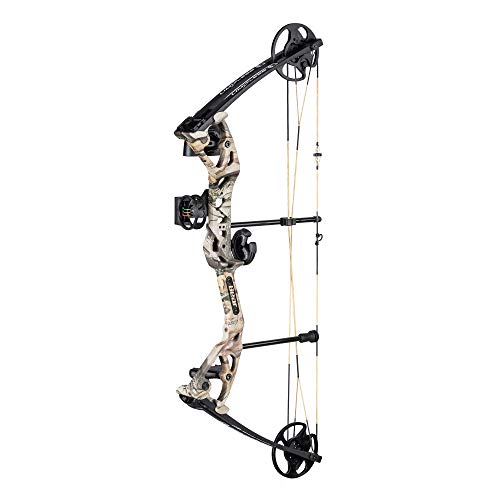
Bear Archery Limitless Youth Compound Bow
Adjusts 25 to 50 lb and 19 to 29 inches without a bow press, and ships with sight, Whisker Biscuit rest and quiver fitted. It follows a growing archer for years instead of being outgrown in a season.
Best for: Youth archers and smaller-framed adults who want a complete package.
Check price
Diamond Archery Edge XT Compound Bow, Right Hand
A Bowtech-derived cam in a wide-adjustment package, and it arrives with sight, rest, quiver and stabilizer already fitted rather than as a bare bow you then spend another $300 on.
Best for: Adults who want to be shooting the week the box arrives.
Check price
Bear Archery Cruzer G4 RTH Compound Bow, Right Hand
The widest adjustment range you can buy at this price: 10 to 70 lb draw weight and 14 to 30 inch draw length, all without a press. One bow covers a beginner at 40 lb and the same archer at 65 lb three seasons later.
Best for: A first serious hunting rig, or one bow that fits the whole household.
Check price
PSE Stinger ATK Compound Bow Package, Right Hand 70 lb
A stiffer riser and a more aggressive cam than the entry packages, which means more speed and a firmer back wall, but also a narrower adjustment window and less forgiveness of a wandering anchor point.
Best for: Archers who already know their draw length and shoot 60 lb comfortably.
Check priceMathews Lift X 33
Flagship hunting and target bow. Mathews sells through authorised dealers only, so treat this as a fitting appointment with draw length and module work included, not an online order.
Best for: Experienced archers being professionally fitted. Not a first bow.
Find on AmazonPrices change often, confirm on Amazon. As an Amazon Associate we earn from qualifying purchases.
How we chose these bows
We compared published manufacturer specifications, verified owner reviews and pro shop guidance, and ranked on four things a new archer actually feels. First, draw length range, because a bow that cannot reach your measurement is unusable and a bow that only just reaches it will need replacing. Second, draw weight range, because starting light and working up is how you build form instead of habits you will spend years unlearning.
Third, whether adjustment requires a bow press. Every bow on this list changes draw weight with a hex key on the limb bolts, and the top four change draw length with a rotating module rather than a press and a new cam. That difference is the gap between adjusting your bow in the garage and paying a shop every time you grow. Fourth, what is in the box, since a bare bow needs $250 to $400 of accessories before you can shoot it at all.
We do not test bows in person. Everything below is drawn from published specifications, brand documentation and owner reports, and prices change constantly.
Specifications compared
| Bow | Price | Draw weight | Draw length | Package included |
|---|---|---|---|---|
| Genesis Original | $164.99 | 10-20 lb | 15-30 in | Bow only or kit |
| Bear Limitless | $188.20 | 25-50 lb | 19-29 in | Yes, ready to hunt |
| Diamond Edge XT | $383.83 | 7-70 lb | 15-31 in | Yes, fully accessorized |
| Bear Cruzer G4 | $419.99 | 10-70 lb | 14-30 in | Yes, ready to hunt |
| PSE Stinger ATK | $581.90 | Up to 70 lb | 21.5-30 in | Yes, package |
Draw length is the specification that decides everything
A compound bow has a hard wall at full draw. Unlike a recurve, you cannot simply pull a little further, so the bow has to match you rather than the other way round. Estimate yours by measuring your wingspan in inches and dividing by 2.5, rounded to the nearest half inch. A 70 inch wingspan gives a 28 inch draw. Our draw length calculator does the arithmetic and shows the range you should be shopping inside.
Get it wrong long and you will creep forward at anchor, slap your forearm with the string and lose consistency. Get it wrong short and you lose both power and a repeatable anchor point. This is the specification to confirm with a pro shop before you spend anything above the entry tier, because an adjustable bow forgives an estimate and a fixed-length bow does not.
Start lighter than the marketing suggests
Draw weight is where beginners overreach most often. A bow you can only draw by pointing it at the sky and hauling is a bow that will teach you bad form. Most adult men start well between 45 and 55 lb, most adult women between 30 and 40 lb, and every bow above turns down with the limb bolts.
Two safety points that are not optional. First, check the legal minimum draw weight for bowhunting in your state, which is commonly around 40 lb and is set by regulation, not preference. Second, never shoot an arrow lighter than 5 grains per pound of draw weight. At 60 lb that is a 300 grain floor. Going under it is close to a dry fire, risks damaging the limbs and cams, and voids the warranty on every bow listed here. Run your setup through the total arrow weight calculator before you buy arrows.
What the package accessories are really for
Ready-to-hunt packages ship with a multi-pin sight, a Whisker Biscuit style rest, a quiver, a stabilizer and usually a peep and D-loop installed. None of it is top-tier, and that is the point. The bundled parts are good enough to learn on and cheap enough that replacing them one at a time feels like progress rather than waste.
The usual upgrade order is sight first, then rest, then release. A better bow sight changes what you can see and how precisely you can aim, a better arrow rest changes how cleanly the arrow leaves, and a better release aid changes how the shot breaks. Arrows are the exception: buy correctly spined arrows immediately, because the wrong spine will make a good bow look broken.
Who should not buy the Expert tier
The PSE Stinger ATK and any dealer-only flagship like the Mathews Lift are excellent bows and the wrong first purchase for most people. They have narrower draw length windows, stiffer risers and more aggressive cams, which means a shorter valley and a firmer wall that punishes an anchor point that is still moving around.
Skip the Expert tier if you have not had your draw length measured at full draw, if you cannot yet draw 60 lb smoothly without raising the bow above horizontal, or if you are still deciding whether you want to hunt at all. The gap between a $420 Cruzer and a $1,200 flagship is real, and it is entirely invisible until your form is repeatable. Money spent on arrows, a good target and lessons buys more accuracy than money spent on a riser at this stage.
Buying tips
- Buy the right hand. Right-handed bows are held in the left hand and drawn with the right. Hand is set by your dominant eye, not your writing hand, and it cannot be changed after purchase.
- Budget for the second purchase. A dozen arrows, a target and a release add roughly $200 to $300 on top of the bow. Plan for it rather than discovering it.
- Have a shop set the peep and D-loop. Even on a ready-to-hunt package, peep height is personal and takes a few shots to place correctly.
- Ignore IBO speed. It is measured at a 30 inch draw, 70 lb and a 350 grain arrow. If you shoot 28 inches at 55 lb with a 420 grain arrow, you will never see the number on the box, and it does not matter.
- Check the string condition on arrival. Waxed, unfrayed, no separated strands. Serving separation around the D-loop is a shop visit, not a shooting session.
- Ask about the module system before you buy used. Some bows change draw length with a rotating module, others need a whole new cam.
Related reading
- Arrow spine calculator, match shaft stiffness to your new bow before you buy a dozen arrows
- Arrow kinetic energy calculator, KE and momentum for your draw weight
- Best hunting arrows, the purchase that follows the bow
- Best archery rangefinder, the accessory that fixes more misses than any bow upgrade
Frequently asked questions
What is the best compound bow for a beginner?
For most adult beginners the Bear Cruzer G4 RTH at around $420 is the strongest choice, because it adjusts from 10 to 70 lb and 14 to 30 inches without a bow press and arrives with sight, rest and quiver fitted. Younger or smaller archers are better served by the Bear Limitless at around $188. If you have never drawn a bow at all, the Genesis Original removes draw length from the equation entirely.
What draw weight should a beginner start at?
Lower than you think. Most adult men are well served starting between 45 and 55 lb and most adult women between 30 and 40 lb, then adding weight as the shooting muscles develop. Starting too heavy is the single most common beginner mistake because it wrecks form, encourages short-drawing and makes practice unpleasant. Check your state hunting minimum, which is commonly around 40 lb, before you settle on a number.
Do I need a ready-to-hunt package or a bare bow?
Buy the package. A bare bow still needs a sight, rest, quiver, stabilizer, D-loop and peep, which adds $250 to $400 and a shop visit before you can shoot once. Package accessories are basic rather than bad, and they let you learn what you actually want to upgrade. Replacing a bundled sight later costs $100 and is a normal part of the progression.
How do I know what draw length I need?
Measure your wingspan fingertip to fingertip and divide by 2.5, then round to the nearest half inch. That estimate is close enough to buy an adjustable bow with, but it is not close enough to shoot competitively with. A pro shop measuring you at full draw will refine it, and draw length errors show up as a collapsed anchor, string slap on the forearm, or groups that will not tighten no matter how much you practise.
Should a beginner buy a used compound bow?
Only with a shop inspection. Compound bows store enormous energy in their limbs and cables, and cracked limbs, frayed strings and dry-fire damage are not always visible. A used flagship can be excellent value, but budget $80 to $150 for new strings and a full tune, and never buy one whose draw length range does not already cover you.
How much should I spend on my first bow?
Between $190 and $450 covers the sensible range for a complete, adjustable, ready-to-shoot package from a real archery brand. Below that you are usually buying an unbranded bow with no parts support. Above it you are paying for speed and adjustability at the margins that a new archer cannot yet use, and that money is better spent on arrows, a target and lessons.
How we choose: we compare published manufacturer specifications, verified owner reviews, and pro shop guidance. We do not test gear in person. Draw weight and arrow spine affect safety, so follow your bow manufacturer's specifications and have setup work checked by a qualified pro shop.