Best Hunting Arrows in 2026: Spine, Weight and FOC
The Gold Tip Hunter XT ($74.99 for six) is the best hunting arrow for most bowhunters, combining tight weight and straightness tolerance with a shaft that survives target practice. The Easton Axis 5mm ($94.98 for six) is the better choice for penetration-focused builds. Spine must always be matched to your draw weight, arrow length and point weight.
Arrows are the only part of your setup that leaves the bow, which makes them the component where a mismatch is least forgiving. The right arrow is defined by your bow, not by the brand on the shaft, and the number that matters most is spine.
Below are picks from $50 to $171, plus the specifications that decide which of them is correct for you. The short version: get spine right first, weight second, and straightness tolerance last.
Best hunting arrows by experience level

Gold Tip Hunter Arrows with Raptor Vanes, 340 Spine, 6-Pack
Fletched, cut and ready to have inserts glued, from a shaft maker with real straightness tolerances. Buying six at a time is the honest way to start, because your first season will cost you arrows.
Best for: A first set of hunting-weight arrows. Confirm the spine against your setup.
Check price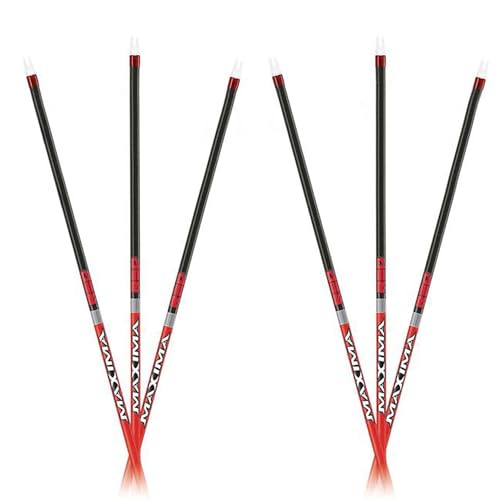
Carbon Express Maxima RED Fletched Arrows, 350 Spine, 6-Pack
Dynamic Spine Control stiffens the two ends of the shaft to contain flex toward the middle, which makes cut length less punishing to get slightly wrong. One shaft covers two traditional spine sizes.
Best for: Archers whose draw length sits awkwardly between two spine charts.
Check price
Gold Tip Hunter XT Arrows with Raptor Vanes, 340 Spine, 6-Pack
Tighter straightness and weight tolerance than the standard Hunter, in the same tough shaft. It is the arrow a lot of pro shops hand you when you ask for something that just works.
Best for: Bowhunters who want consistency without paying custom-shaft prices.
Check price
Easton Axis 5mm Carbon Arrows with HIT Inserts, 400 Spine, 6-Pack
A small 5mm diameter and a heavy wall, so the shaft carries more weight per inch and presents less surface to drag on the way through. The HIT insert seats inside the shaft rather than over it.
Best for: Bowhunters prioritising momentum and durability over flat trajectory.
Check price
Victory VAP TKO Elite Fletched Arrows, 300 Spine, 6-Pack
Sorted to plus or minus .001 inch straightness. That tolerance only shows up past 60 yards or in a scoring ring, and it is invisible at 25 yards behind a shaky anchor point.
Best for: Long-range practice and competition. Overkill for a 20 yard treestand.
Check price
Easton 5mm FMJ Arrow Shafts with HIT Inserts, 300 Spine, 12-Pack
A carbon core inside an aluminium jacket. Heavy, quiet and slick through a target, and the platform most heavy-arrow and high-FOC builds start from. Bare shafts, so budget for fletching.
Best for: Archers building a heavy arrow deliberately, with the tools to fletch it.
Check pricePrices change often, confirm on Amazon. As an Amazon Associate we earn from qualifying purchases.
Read this before you order a spine
Every arrow above is sold in several spines, and the spine listed on each card is one of them, not a recommendation. Spine is dynamic. It describes how much the shaft flexes as it accelerates, and four things change it: draw weight, arrow length, point weight and how aggressive your cam is. A heavier point weakens dynamic spine. A longer shaft weakens it too. Turning your limb bolts down stiffens it in relative terms.
That is why two archers shooting the same bow model can need different shafts. Start with the arrow spine calculator, using your real cut length measured throat of nock to back of insert, then confirm with a paper tune before you commit to a dozen. Ordering by draw weight alone is the most common way to end up with arrows that will not group and a bow you wrongly blame.
How we chose these arrows
We compared published manufacturer specifications, verified owner reviews and pro shop guidance across four criteria. Availability across spines came first, because an arrow that only exists in two stiffnesses cannot serve most readers. Weight tolerance came second: shafts sorted to a tight grain window group better than shafts sorted for straightness alone, and it is the specification hunters feel first.
Durability came third, since hunting arrows spend most of their lives being shot into targets rather than at game, and a shaft that splinters on a nock-to-nock impact is expensive. Insert system came fourth, because internal HIT-style inserts and steel half-outs change both FOC and how the front end survives a hard hit.
We do not test arrows in person. Everything here is drawn from published specifications and verified owner reports.
Arrows compared
| Arrow | Price | Pack | Straightness | Fletched |
|---|---|---|---|---|
| Gold Tip Hunter | $49.99 | 6 | ±.006 in | Yes |
| Carbon Express Maxima RED | $73.28 | 6 | ±.0025 in | Yes |
| Gold Tip Hunter XT | $74.99 | 6 | ±.003 in | Yes |
| Easton Axis 5mm | $94.98 | 6 | ±.003 in | Yes |
| Victory VAP TKO Elite | $134.99 | 6 | ±.001 in | Yes |
| Easton 5mm FMJ | $170.99 | 12 | ±.003 in | No, bare shafts |
Weight, energy and the safety floor
Total arrow weight drives penetration far more than raw speed does. Kinetic energy is grains x fps² / 450,240 and momentum is grains x fps / 225,218, and momentum is the better predictor of how an arrow behaves once it meets resistance. That is why heavy arrow builds keep gaining ground even though they shoot flatter on paper when they are light. Run your figures through the kinetic energy calculator.
There is a hard limit at the light end. Never shoot an arrow lighter than 5 grains per pound of draw weight. At 60 lb that is a 300 grain floor, at 70 lb it is 350 grains. An underweight arrow does not absorb enough of the bow's stored energy, which sends the remainder back into the limbs and cams. It is close to a dry fire, it can destroy a bow, and it voids the warranty on every model listed on this site. Check your build with the total arrow weight calculator before you shoot it.
On the practical side, most whitetail setups land between 400 and 500 grains total, including point, insert, nock and vanes. Heavier arrows lose trajectory, which means your pin gaps stretch and range estimation errors cost more. Roughly, expect about 1 fps lost per 3 grains added above 350.
Who should not buy the Expert tier
The Victory VAP TKO Elite is sorted to plus or minus .001 inch, and that tolerance is real. It is also invisible at the distances most bowhunting happens at. The Easton FMJ shafts are bare, which means you need a fletching jig, glue, vanes and the willingness to build your own arrows.
Skip the Expert tier if you have not yet confirmed your spine with a paper tune, if you shoot mostly inside 30 yards, or if you do not own fletching equipment and were not planning to. Tolerance is the last variable that matters, well behind spine, rest timing and a repeatable anchor point. A $50 set of correctly spined Gold Tip Hunters on a tuned bow will outgroup $135 arrows on an untuned one, every time.
Buying tips
- Have your first dozen cut at a shop. Cut length changes dynamic spine, and a shaft cut a half inch short cannot be uncut.
- Buy a dozen, not six, when you can. Same batch means same behaviour between practice arrows and hunting arrows.
- Weigh your points. Field points and broadheads are sold at the same nominal grain weight and can differ by several grains, which changes FOC and impact point.
- Inspect carbon shafts after every hard impact. Flex the shaft and listen for cracking. A splintered carbon arrow can injure your bow hand badly on release. Retire anything suspect.
- Match broadhead weight to what you tuned with. Switching from 100 to 125 grains weakens dynamic spine and will move your point of impact.
- Number your arrows. When one consistently lands away from the group, you want to know which one it is rather than suspecting the bow.
Related reading
- Arrow speed calculator, see what added arrow weight costs you in fps
- Arrow FOC calculator, work out front of centre before you change point weight
- Best arrow rest, rest timing and spine produce identical looking tears
- Best archery rangefinder, heavier arrows make range estimation errors more expensive
- All archery calculators
Frequently asked questions
What are the best hunting arrows?
For most bowhunters the Gold Tip Hunter XT at around $75 for six is the best balance of straightness tolerance, durability and price. Budget shooters should look at the standard Gold Tip Hunter at around $50, and archers prioritising penetration should consider the Easton Axis 5mm, whose small diameter and heavy wall carry more weight per inch. Spine must be matched to your setup in every case.
How do I know what arrow spine I need?
Spine is dynamic, not a single number off a chart. Draw weight, arrow length, point weight and cam aggression all shift it, and a heavier point or a longer shaft both weaken dynamic spine. Start with a manufacturer spine chart using your real draw weight and cut length, then confirm by paper tuning or bare shaft tuning. Our arrow spine calculator gives you the starting point in seconds.
How heavy should a hunting arrow be?
Most whitetail setups land between 400 and 500 grains total, with heavier builds running past 550 for larger animals. The hard floor is safety rather than performance: never shoot an arrow lighter than 5 grains per pound of draw weight. At 70 lb that is 350 grains. Going under risks limb and cam damage and voids the warranty on every modern compound bow.
Does arrow straightness tolerance actually matter?
Less than the marketing implies at hunting distances. The difference between plus or minus .006 inch and plus or minus .001 inch is measurable past 60 yards and effectively invisible at 25 yards behind an anchor point that still moves. Consistent weight across a dozen shafts matters more for most hunters, and correct spine matters more than either. Buy tolerance last, after tuning.
What is FOC and what should mine be?
FOC is front of centre, the percentage of the arrow weight biased toward the point. Calculate it as balance point minus half the arrow length, divided by arrow length, times 100. Target archers generally run 7 to 12 percent, hunters 10 to 15 percent, and extreme FOC builds go past 19 percent. Higher FOC stabilises the arrow faster and steepens trajectory, so it is a trade rather than a free upgrade.
How many arrows should I buy?
Buy at least a dozen matched shafts if you can, and six at minimum. Arrows are consumables: you will break some, lose some in the grass and retire some after a hard impact. Buying a dozen of the same spine and weight from the same batch also means your hunting arrows and your practice arrows behave identically, which is the point of matched shafts.
How we choose: we compare published manufacturer specifications, verified owner reviews, and pro shop guidance. We do not test gear in person. Draw weight and arrow spine affect safety, so follow your bow manufacturer's specifications and have setup work checked by a qualified pro shop.