Best Archery Gloves and Armguards in 2026
The Easton Deluxe Oval Armguard ($15.87) is the best armguard for most archers because its curved shell sheds the string instead of catching it. For fingers, the Bear Archery 3-finger glove ($15.99) is the easiest start and the SAS Barebow tab ($19.99) is the cleanest cheap release. Competitive recurve archers should buy the AAE Cavalier Cordovan Elite tab ($73.61).
Gloves, tabs and armguards are the cheapest gear on a bow and the closest to the shot itself. Everything the string does passes through your fingers and past your forearm, so a tab that folds or a guard that rotates changes the release directly. The good news is that the whole category is inexpensive, and nothing here needs to be replaced with something expensive to work correctly.
Six picks follow across three tiers, covering both halves of the problem: protecting the bow arm and controlling the string hand. The single most useful thing on this page is not a product, it is the reason the string is hitting your arm at all, and that is fixable for free.
Best archery gloves, tabs and armguards by level

SAS 8 inch Archery Armguard with 3-Strap Buckles
Three straps instead of two, which is what keeps a guard from rotating on the forearm mid-session. Eight inches covers the part of the arm a string actually finds.
Best for: A first armguard for a beginner still fixing elbow rotation.
Check price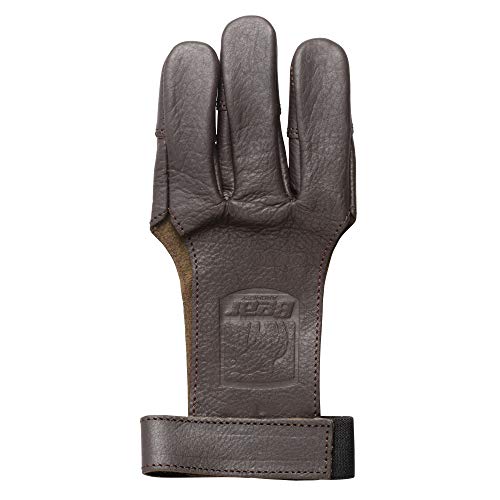
Bear Archery Leather 3-Finger Traditional Shooting Glove
Plain leather fingerstalls from a brand that has made them for generations. A glove keeps the string on your fingertips, which is the easier feel to learn first.
Best for: Traditional and recurve archers starting out.
Check price
Easton Deluxe Oval Armguard
A curved shell that follows the forearm rather than sitting proud of it, so the string sheds off instead of catching an edge. Elastic strapping stays put through a long line.
Best for: Target archers shooting high volume on a shooting line.
Check price
Bohning Slip-On Archery Armguard
No buckles to snag on a sleeve and nothing to adjust in the dark. It goes on like a sleeve and stays where it was put, which is the whole argument for the style.
Best for: Bowhunters wearing layers who cannot fuss with straps.
Check price
SAS Barebow Suede and Leather Finger Tab, Medium
A tab gives a cleaner string release than a glove because the string slides off one flat surface instead of three separate fingers. This is the cheapest honest way to find that out.
Best for: Recurve and barebow archers moving off a glove.
Check price
AAE Cavalier Cordovan Elite Finger Tab
Cordovan facing over an aluminium plate, with an adjustable finger spacer and ledge. Cordovan is used because it stays consistent shot to shot instead of compressing as it warms up.
Best for: Competitive recurve archers chasing release consistency.
Check pricePrices change often, confirm on Amazon. As an Amazon Associate we earn from qualifying purchases.
How we chose
Selections are based on published specifications, cross-checked against verified owner reviews and coaching guidance. We do not test gear in person. In a category this cheap the risk is not that an expensive item disappoints, it is that a badly shaped item quietly teaches a bad habit, so shape and fit drove the picks.
Three criteria. Retention: a guard that rotates on the forearm mid-session is worse than none, because you stop trusting it and start flinching. Three straps, or a slip-on sleeve, solve this where two straps do not. Profile: the shell should follow the arm, since a flat plate on a round arm leaves an edge for the string to catch. Facing consistency: on tabs, the material that touches the string is the whole product. Cheap leather compresses into a groove and changes feel within weeks; cordovan does not, and that difference is the only reason a $74 tab exists.
Fix the cause before you buy the cure
String slap is a symptom. The string is hitting your arm because your arm is in its path, and there are exactly three usual reasons.
The first is a locked elbow. Straightening the bow arm completely rotates the inside of the forearm into the string. Keep a slight bend and rotate the elbow crease outward, away from vertical, and the arm leaves the string path entirely. The second is grip: squeezing the handle torques the bow and drags the arm in. Let the bow sit in the web of the hand with a relaxed grip. The third is draw length, which is the one that needs measuring rather than adjusting. If your draw length is too long you are forced to over-extend, and no amount of technique fixes a bow that does not fit. Check yours against the draw length calculator, since wingspan divided by 2.5, rounded to the nearest half inch, gets most archers very close.
Buy the armguard anyway. It costs about $12, it keeps loose sleeves out of the string, and it stops one painful hit from teaching you to flinch while you correct the underlying cause.
| Item | Type | Price | Retention | Best discipline |
|---|---|---|---|---|
| SAS 8 inch Armguard | Armguard | $10.99 | 3 straps | Beginner, any bow |
| Easton Deluxe Oval | Armguard | $15.87 | Elastic straps | Target and range |
| Bear Archery 3-Finger Glove | Glove | $15.99 | Wrist strap | Traditional and hunting |
| SAS Barebow Tab | Finger tab | $19.99 | Finger loop | Barebow and recurve |
| Bohning Slip-On Armguard | Armguard | $20.71 | Sleeve | Bowhunting in layers |
| AAE Cavalier Cordovan Elite | Finger tab | $73.61 | Finger loop and ledge | Competitive recurve |
Who should not buy the Expert tier
The AAE Cavalier Cordovan Elite is a competition tab, and it costs roughly four times a decent leather one. Its advantage is consistency over volume: cordovan holds its shape where ordinary leather compresses into a groove, and the adjustable spacer and ledge give a repeatable anchor.
That only pays off if you shoot enough for a tab to wear out and if your form is repeatable enough that a tab is now the limiting factor. Do not buy it if you shoot a compound with a release aid, since it does nothing for you at all. Do not buy it as a beginner, because your hand position is still changing and the adjustment range will be set to the wrong place. And do not buy it if you shoot occasionally, since a $20 tab lasts years at low volume. If you are shooting a few hundred arrows a week and wearing through tabs, it is a sensible purchase.
Glove or tab, in practical terms
A glove keeps the string on your fingertips. It is warm, it stays on your hand between shots, and it does not need to be found in a pocket at the moment a shot presents itself. That convenience is why traditional and hunting archers largely shoot gloves.
A tab puts one flat, smooth surface between string and fingers, so the string leaves cleanly and identically every time. That consistency is why target archers largely shoot tabs. The trade-off is that a tab is a separate object you have to hold on to, and in cold weather it is less pleasant.
Either way, one thing is not optional: protect your fingers before you shoot a recurve or longbow at all. Bare fingers on a string at even modest poundage produce blisters within a session and a flinch shortly after, and a flinch is far harder to unlearn than it was to acquire. If you are choosing between a compound with a release and a recurve with fingers, the compound versus recurve comparison covers what else changes with that decision.
Sizing and fitting, which is most of the value
Nothing here works if it fits badly, and fit is where cheap items succeed or fail rather than where money buys quality.
An armguard should sit on the inside of the forearm covering the area between wrist and elbow crease, snug enough that it cannot rotate but not tight enough to restrict blood flow. Six to eight inches suits most adults. If the string is reaching above the guard, the answer is a longer guard and a technique fix, not a tighter strap. For a glove, the fingerstalls should reach past your fingertips with a little room, because a stall that is too short lets the string bite the end of your finger, and one that is far too long folds and changes the release.
For a tab, the facing covers the pads of the first three fingers and stops at the fingertips. Too large and the surplus folds under the string, too small and the string finds skin. Between sizes, choose the smaller. Finally, keep all of it consistent: switching between a glove and a tab changes where the string sits on your fingers, which moves your point of impact just as surely as moving the sight would.
Buying tips
- Buy the armguard first. It is the cheapest item here and the one that prevents a habit rather than fixing gear.
- Three straps beats two. Rotation is the failure mode that makes archers stop wearing a guard.
- Size tabs to your fingers, not your gloves. Between sizes, go smaller so nothing folds under the string.
- Buy two identical tabs if you shoot volume. Rotating them keeps both from wearing a groove, and you have a spare.
- Check for a spacer. A finger spacer stops you pinching the nock, which is a common and invisible cause of erratic arrow flight with fingers.
- Try before committing to cordovan. The premium only makes sense once your release is repeatable enough to notice the difference.
Related reading
- Compound versus recurve bow, fingers against a release aid
- Draw length calculator, the usual cause of string slap
- Arrow spine calculator, since finger shooters need different spine than release shooters
- Best bow quivers, the next low-cost accessory worth getting right
Frequently asked questions
What is the best archery armguard?
For most archers the Easton Deluxe Oval at around $16 is the best pick, because its curved shell follows the forearm so the string sheds off rather than catching an edge. Beginners still fixing elbow rotation get more from a longer three-strap guard such as the SAS 8 inch at around $11, since coverage matters more than profile while the string is still hitting you.
Glove or finger tab for archery?
A tab gives a cleaner release because the string slides off one smooth surface rather than three separate fingertips, and it wears evenly so the feel stays consistent. A glove is more convenient, stays on your hand between shots and suits traditional and hunting use in cold weather. Target and competitive recurve archers almost universally shoot tabs. Start wherever you like, but try both.
Do compound archers need an armguard?
Usually not, because a release aid and a proper stance keep the string clear of the forearm. Compound archers who do get string slap are usually over-extending the bow arm or gripping too hard, which rotates the elbow into the string path. In that case the armguard treats the symptom while you fix the cause. It is still useful for keeping loose sleeves out of the string.
How do I stop the string hitting my arm?
Rotate the bow-arm elbow outward so the inside of the forearm turns away from the string path, and stop locking the elbow straight. A slight bend plus rotation moves the arm out of the way entirely. Check grip too, since a tight grip torques the bow and pulls the arm in. Also check brace height and draw length, because a draw length that is too long forces over-extension.
What size finger tab do I need?
Tabs are sized so the facing covers the pads of your first three fingers without extending past the fingertips, where the extra material would fold under the string. Measure across your fingers and follow the maker chart rather than assuming your glove size carries over. If you are between sizes, choose the smaller one, since a tab that is too large moves under tension and changes the release.
How long does a leather finger tab last?
A basic leather tab shooting a few hundred arrows a week will typically want replacing within a season, because the facing compresses where the string sits and the groove changes your release feel. Cordovan facings last far longer and hold their shape, which is exactly why competitive archers pay for them. Rotate two tabs if you shoot high volume so neither wears into a groove.
How we choose: we compare published manufacturer specifications, verified owner reviews, and pro shop guidance. We do not test gear in person. Draw weight and arrow spine affect safety, so follow your bow manufacturer's specifications and have setup work checked by a qualified pro shop.